Launching Iluria: Looking in on the Early Stages of a Startup with Hagay Levy


 Apple Podcasts
 Spotify
 Overcast
 Castro
 PocketCasts
 RSS Feed
 Startup founder and father to four children with ADHD/ADD, Hagay Levy joins the show today to share his entrepreneurial journey thus far. As a man who also has ADHD himself, he knows much about the unique needs of folks in that community, of which our host, Mai Ling Chan, is also a member. Hagay speaks with Mai Ling about his quest to start Iluria, a new tool for measuring the efficacy of medication for people with ADHD/ADD. They talk about identifying the problem, building a solution to the problem, some of the challenges along the way, what’s been accomplished thus far, and where Iluria is headed next.
Contact Mai Ling: MLC at mailingchan.com
Contact James: James at slptransitions.com
[00:00:00] James Berges: 99% of our guests are people who've built the thing, won the award. They're on the other side of it. Today's guest isn't there yet.
[00:00:07] Mai Ling Chan: No, he's not, and that's exactly why I wanted him on our show. I met Hagai Levy a few months ago and heard he was building Eloria, an app that pairs with a wearable to capture the physical impact of medication for ADHD, and I wanted us to go on this journey with him.
[00:00:26] Hagay Levy: We were very surprised to find out that, that there are dozens over dozens of clinical studies prior to the studies that we've done showing, okay, if a treatment is effective, you will see a reduction in movement. You will see a reduction in angular movement. You will see an increase in heart rate. But, but it was very noisy.
[00:00:42] Hagay Levy: You cannot really measure movement and say, "Okay, it's moving less, it's working." It's very noisy. Once we compounded everything and included all of the markers, and then deployed machine learning, all of a sudden the picture became much clearer with respect to the patterns and the significance.
[00:00:57] Mai Ling Chan: Welcome to the Exceptional Leaders Podcast.
[00:00:59] Mai Ling Chan: I'm Mai Ling Chan, and together with James Berges, we're getting you top tips and resources for building and scaling your disability-focused offerings straight from the forefront of disability advocacy and leadership
[00:01:13] Mai Ling Chan: So Haggai's son has ADHD, was on medication, and wasn't picking up on reading. And every parent listening knows this rollercoaster. You know, is it the medication? Is it the dosage? Is it the kid just growing? And you get a report from the teacher saying he's doing fine, I put that in quotes, but fine is that he's just not a problem.
[00:01:30] Mai Ling Chan: Maybe he's actually sitting there like a zombie.
[00:01:33] James Berges: Right. It's like, is he, is he fine or is he just not interrupting the class? Which is totally different thing. And most parents, I think, would just go back to the doctor and try the next thing.
[00:01:43] Mai Ling Chan: Yeah, that's what most of us do, but Haggai took a different road.
[00:01:46] Mai Ling Chan: Here's what he actually did. He ordered a wearable off the internet, got his son to keep it on, and started charting the physiological and prescription interaction data himself, medicated days against unmedicated days, and then he took the whole thing to a friend who just happened to be a world-renowned biologist.
[00:02:03] James Berges: Of course. Why don't we all have a friend who's a world-renowned biologist? I mean, besides that, having a friend like that, we are getting better at tracking things within our own body, maybe to a fault, but I think in this use case, it's more important than tracking our steps. I mean, with ADHD, you have so many interaction effects of medication.
[00:02:23] James Berges: There's that piece, but there's also just even the visual component that helps us stay organized and capture how these drugs are affecting us. You know, to go back to the doctor and say something besides, "I felt like a zombie," or, "My son was being hyperactive." So the kid feels empowered with visuals, and the parents have that objective data to not feel overwhelmed, and they have something to advocate with.
[00:02:44] Mai Ling Chan: Exactly. And I love that this is a family platform or software, and I've shared this before, that I have ADHD, and it runs in my family, and so this one's very personal for me because, you know, I really want to help to find the answers. You know, what are the medica- medications that work and which are the ones that really aren't working?
[00:03:03] Mai Ling Chan: Um, and I mentioned I fell out, like, fell out of my chair four times during this conversation because it was like, "Yes, yes, that's what we need." You know? I was so excited. So thank you for- Yeah ... for giving me the, um, the grace to be able to have someone on who's a little bit earlier in their journey, but I'm just really excited to share that people are working, you know, in this really important space.
[00:03:22] James Berges: Absolutely. And so whether you're a parent in the middle of this ADHD medication rollercoaster or a clinician watching families go through it, or you're kind of on that entrepreneurial journey wondering what it takes to build something out of a problem that you found in your own house, this is a great episode for you.
[00:03:39] James Berges: Let's get into it.
[00:03:45] Mai Ling Chan: So today's episode is very interesting. I have my new friend, Hagai Levi, here with me today, and he's an international guest, so we'll hear more about where he's from and what he does. But I wanna let my listener know that throughout the year, James and I get many different emails, um, from people who are introducing us to potential guests, and we only do 12 episodes a year now, which is once a month.
[00:04:07] Mai Ling Chan: And it is, I'm sure you know, very difficult to decide, you know, who we can spotlight each month. And so most of the time, um, I'm gonna say 99% of the time, we are looking to share stories of people who have success. And the story, the episode, is about the challenge to getting there and the overcoming, you know, whether it's personal, it's, um, you know, based on our, our community, um, based on your experiences, all of that.
[00:04:34] Mai Ling Chan: So for 99% of our guests, the person that you're hearing has moved through all of the stages and now are at a success level. And I wanna put that in quotes 'cause we're always learning and growing. Haggai, as my guest today, is very special to me because when I learned about his product, I actually felt there was a personal connection because I also have ADHD, and we have family members that have ADHD.
[00:04:57] Mai Ling Chan: And I'm really so excited about this space that he's in, and he is the typical mom-and-pop type of product, but it is high tech, which is also really exciting. And so I wanted you, our listener, to hear this story, and I want to go on this journey together with him. And, and I want to support him and his family, and I'm so excited about this technology.
[00:05:18] Mai Ling Chan: So welcome, Haggai. I'm really excited to hear your story. And let's start with just a little bit about you, where you're from, and how you got involved.
[00:05:27] Hagay Levy: Super. First of all, pleasure, uh, to be here. Thank you for having me. Super appreciated. So, uh, Haggai Levy. Uh, born, raised, and live in Israel. Uh, mid-50s, did, you know, like the regular pathways, several years in the army.
[00:05:42] Hagay Levy: Actually majored in finance. After that, uh, started off my career in the capital markets, like 250 years ago. Then moved to the high-tech industry. Uh, served for many years in multiple senior positions, uh, in, in many verticals. I did a lot of go-to-market, but I was actually CFO for the majority of the years.
[00:06:02] Hagay Levy: So I, I've been around. You mentioned the, uh, mom-and-pop store venture in, in our case. First of all, I have AD- ADHD myself. Mm. But I'm in my mid-50s, uh, the second part of m- uh, my, of my mid-50s, so in my generation, maybe now gen- I- no one really knew what it was, and we had to like, you know, scratch our way through everything, hoping to end up on the bright side of the moon-
[00:06:26] Hagay Levy: and not on the dark side of the moon. Uh, if you look at adults with ADHD, statistically, there's no middle. 40% are entrepreneurial, 60% are prisoners- Wow ... and the rest is vulnerable- Wow ... on both sides. Think my wife still questions whether I ended up here or there. Yeah. I hope it's on
[00:06:41] Mai Ling Chan: the bright
[00:06:43] Hagay Levy: side. What side are we?
[00:06:43] Hagay Levy: I, I, I, ho- I, I tend to move, but, but I, I, I think it's the bright side. But, but again, this is me, and that was like, you know, ages ago. Obviously now the awareness is totally different. Uh, uh, I have four kids together with my wife- All four of them are diagnosed with ADHD- Wow ... with or without hyperactivity. We learn very, very quickly that, uh, first of all, it's an attribute.
[00:07:07] Hagay Levy: Again, technically it's a disorder, uh, a disability, lack of dopamine, but practically, it's, it's, it's an attribute. You can leverage it, uh, use the internal engine. I mentioned it by the dark side, or, or ignore it and then maybe suffer from the consequences. But, but-
[00:07:22] Mai Ling Chan: It's my superpower ... we learn- It's mine.
[00:07:24] Mai Ling Chan: Yeah.
[00:07:25] Hagay Levy: You, you are, you're entrepreneur. Again, uh, uh, the statistics are very, very clear. You will barely find any local, uh, plain vanilla people who are... I, I mean either, either it pulls you here or there. So again, just l- looking at statistics, again, it, there's, it's not one size fits all. Obviously each and every case has its own, like, you know, unique attributes.
[00:07:45] Hagay Levy: But w- we learn very quickly that, uh, the, uh, uh, pharmacological treatments, statistically the best line of defense alongside with the behavioral treatment But when it comes to the pharma, when it comes to the treatment, stimulant, no stimulants, again, there are dozens over dozens of available medications over there.
[00:08:05] Hagay Levy: It's, uh, it's very difficult. Yes. Uh, you don't have any objective data. By the way, on me as well, if I'm taking medication, again, I'm in my... I'm an adult, but I still have to figure out whether I have, uh, uh, I have fo- sufficient focus or not. In the younger population, either elementary school or al- also, uh, uh, after that, uh, up to high school, including, a complete trial and error game.
[00:08:28] Mai Ling Chan: Yes.
[00:08:30] Hagay Levy: Hope that... Le- let's talk about the elementary school. You hope that the teacher will be very accurate in what he or she has to say with respect, not, not only to the efficacy, the safety as well.
[00:08:39] Mai Ling Chan: Yeah.
[00:08:39] Hagay Levy: You will see some side effects, actually, in most of the cases, a- and it's very hard- Mm-hmm ... to balance the equation of let's eliminate side effects, which are, are, are, are doable, obviously.
[00:08:51] Hagay Levy: Again, e- even if my kid, uh, just looks like a zombie.
[00:08:55] Mai Ling Chan: Mm-hmm.
[00:08:55] Hagay Levy: It, it's a no-go.
[00:08:56] Mai Ling Chan: Yep.
[00:08:57] Hagay Levy: And, and obviously some more severe, uh, uh, uh, comorbid conditions or side effects.
[00:09:01] Mai Ling Chan: So I want to add to that. Um, I'm a speech language pathologist, and I've worked in and out of the schools for years, and exactly what you're saying, Hagai, is that when a child is diagnosed with ADHD, and if the parents decide to go on that medication journey, it is such an up and down roller coaster, number one, because like you said, there are so many different options, right?
[00:09:20] Mai Ling Chan: So there's Ritalin, and there's Adavan, and there's all these different options. Then we also have the individual, how that specific child is reacting to that specific medication, and then it's the dosage. So it's the medication, but then it's also the dosage, and then the child is growing. And so the child is constantly changing, and their chemical, you know, um, interactions are changing.
[00:09:43] Mai Ling Chan: And so something that worked six months ago might be changing six months from now. And, and it is such a roller coaster, and I love that you said a lot of this is based on the teacher reporting. So the teacher is saying, you know, "Oh, the kid's doing great." But what if that is the teacher's perspective is, yeah, the kid's, you used the word a zombie.
[00:10:02] Mai Ling Chan: Yes. Like, Johnny just sits there, and he doesn't talk, he doesn't do anything, but he's just a zombie. And then he comes home, and the parents are like, "I don't want him to be like that," right? Or they have him on that medication on the weekend, and they see this really different Johnny, and they're like, "That's not the presentation that I want.
[00:10:17] Mai Ling Chan: He's usually full of life." And that's because they're used to a certain level of Johnny, which is usually like, you know, Johnny off the rails. So-
[00:10:26] Hagay Levy: Precisely.
[00:10:26] Mai Ling Chan: Yes.
[00:10:27] Hagay Levy: I, I couldn't agree. Again, it's not only me. I mean, who am I to declare? But this is always what you hear from physicians. Again, no one knows exactly how the body reacts to the medication or pharmacokinetics, pharmacodynamics.
[00:10:40] Hagay Levy: No one really knows i- if there is, like, an impact or not, what is the duration of the impact, how does the metabolism system work and actually absorb the medication. It, it's a guesstimation And so, so just to close the loop with respect to the problem, and then maybe I can, uh, give you a couple of use cases from my two boys for sake of discussion.
[00:10:59] Hagay Levy: So, so again, the main challenge that, that we encountered was trying to see how to balance the ecosystem of e- eliminating side effects alongside with still measuring that there is some sufficient efficacy and, and it's long enough. With respect to the physicians, it's the inability to shorten the time to the effective treatment while minimizing side effects.
[00:11:18] Hagay Levy: Uh, I, I can tell you maybe two use cases of maybe how Elua started.
[00:11:23] Mai Ling Chan: Yeah.
[00:11:23] Hagay Levy: My youngest son is, is like the mold in which you create ADHD patients, uh, uh, all over the place. Brilliant kid, and, uh, he actually, he actually started taking stimulants, uh, uh, uh, in, in the kindergarten. Again, he, it, it, he couldn't, he couldn't, uh, uh, handle himself without it, and he started first grade with the medication Uh, conserve at 27, and he could not read.
[00:11:48] Hagay Levy: For, like, half a year he could not read. According to the teacher, by the way, excellent teacher, according to the teacher, the medication was effective because, uh, the, the, the impulsivity and the hyperactivity weren't there, but he could not read.
[00:11:59] Mai Ling Chan: Mm.
[00:12:00] Hagay Levy: So she was very, "Look, may- maybe it's another learning deficiency.
[00:12:03] Hagay Levy: I, I don't really know." She started moving into special education. Again, she didn't knew. And we measured him. That was the first measurement that we ever made, and, uh, the, uh... it's, like, only data, it was, like, only data separations back then, not the wonderful curves we're generating. And, and our scientific advisory board, Professor Liran Carmel is one of the world's leading computational biology experts.
[00:12:27] Hagay Levy: He told us, "Look, I have the Off Meds data. I have the Conserve at 27 data. I cannot separate it. It doesn't matter which search patterns I'm using. There is a lot of overlap." So the overall compounded change in the physiology, it's not there. And if you're saying there should be some overall compounded change, I don't see it.
[00:12:45] Mai Ling Chan: Okay, so right there, the average parent, Hagai, now I know this is hard for you because you've been immersed in it for years, okay? The average parent has a child, and they're seeing that their kid is very hyper, right? Or is hyp- uh, what is the other one? Uh, inattentive. Right? They're just zoned out and, you know, it's really hard to get their attention.
[00:13:03] Mai Ling Chan: So these are the two different types of, uh, ADD now, right, is inattentive and, what's it? Hyperactive. Hyperactive. Okay. The average parent sees that kid, and they're used to him, right? So this is just the way Johnny is. They send that kid to school, and the k- so teacher's saying, "You know, he doesn't sit in his chair.
[00:13:22] Mai Ling Chan: He's bothering everybody," or, "When, when I'm trying to give, um, activities, you know, they're not responding." Your child in this case have not able to pick up reading. Okay. So they go to the doctor. They get a prescription, and they don't know to question that. This is what the doctor, you know, prescribed. So now we have this child is in first grade now on, on a prescription, goes to school.
[00:13:43] Mai Ling Chan: The average parent is just reactive, okay? Like, "Okay, well this isn't really working. Let's go back to the doctor." I am, I'm needing a connection here for you. How did you decide that you needed to go talk to a biologist?
[00:13:57] Hagay Levy: So first of all, uh, he's a computational biologist expert, meaning he, he specializes in machine learning, so he's a mathematician But that, that specialize in understanding how to analyze physiological markers for sake of genome research and, uh, whatsoever.
[00:14:15] Hagay Levy: But the basic notion is machine learning. It's mathematics.
[00:14:18] Mai Ling Chan: Mm-hmm.
[00:14:18] Hagay Levy: Again, in our case, designated towards biological or physiological markers changing or physiological mar- changes in physiological markers. But at the end of the day, uh, he's a very close friend, luckily for us, he's one of the world's leading computational biology experts, so we just knocked on his door and told him, "Look at the data, tell us whether you see impact."
[00:14:39] Hagay Levy: And he told us, "I don't."
[00:14:40] Mai Ling Chan: That's amazing. You're just like, "Hey, I'm just..." So where did you get the data from? Did you do blood tests? Is it... What... How did you start with that?
[00:14:47] Hagay Levy: This is a very important question, actually. The holy grail, which is not practical, by no means, is to take blood samples during the day and then see the actual level of medication in the plasma and construct the curves.
[00:15:02] Hagay Levy: Good luck with that. I don't see any kid walking with this butterfly on their hand, and then it's a no-go. Our basic notion is to deliver a proxy for that By mathematically analyzing changes in non-invasive markers using, again, smart wearables. As long as we have movement, angular movement, heart rate, and HRV, heart rate variability, we're good to go, and we can extract a very, very good proxy for the actual impact o- of the medication.
[00:15:33] Hagay Levy: Um-
[00:15:33] Mai Ling Chan: Okay, so I gotta jump in here. So you're like, "Okay, we're not gonna pull blood from my kid, so how am I gonna get some information on what his body is doing on this medication?" And so what was your first way of capturing it?
[00:15:47] Hagay Levy: So, so th- there were, like, the unsupervised measurements, and then the supervised measurements.
[00:15:51] Hagay Levy: In the unsupervised measurements, it was just putting on a wearable. Back then it was, uh, some sort of a Chinese wearable. Uh, we actually extracted the data manually. It, it was a nightmare, but the basic notion was to say, okay, now we have a cloud of data off meds, a cloud of da- data on meds, and let's see whether they overlap or don't.
[00:16:11] Hagay Levy: By the way, when we calibrated, all of a sudden we saw a good separation, and mind you, the kid started reading in a day.
[00:16:17] James Berges: What?
[00:16:17] Hagay Levy: Now it's, uh, it- it's slightly different. Again, we, uh, l- looking at the supervised measurements, we didn't only created the data off and on meds, we actually compared it to questionnaires, to, uh, computerized tests, you know, to FDA cleared solution that showed, okay, the questionnaire says above six ADHD symptoms off meds, below on meds.
[00:16:40] Hagay Levy: The physiology actually changed it, changed dramatically, uh, uh, in a significant manner statistically off and on meds. So, uh, we actually compared it to the DSM-V, the gold standard.
[00:16:51] Mai Ling Chan: Okay, you're still, you're blowing past me, and I don't know if our listener is keeping up, but it's interesting. So for our listener, like, I knew this when I talked to Hagai a couple months ago and I said, "You need to be on the show."
[00:17:01] Mai Ling Chan: We did not talk again until just now, and again, he's blowing my mind, and this is why you're here. Listen to me, I'm so excited, falling out of my chair. Okay, I'm gonna go back to this, Hagai. Again, you don't see how brilliant you are and how just creative, I think that's the other word I want here, so creative as a parent is your son comes home, he's not reading, and he's on these meds, and you're like, "Okay, there's gotta be, there's gotta be some type of interaction here with the medication."
[00:17:28] Mai Ling Chan: That is typical. I'm gonna say every parent who has any kid who puts them on medication and sends them to school, you know, and they- they're gonna say, "It's gotta be the meds, right? Let's... What can we do?" But you take this extra step and you say, "Okay, I need some kind of device that I'm going to be able to find out what is going on physiologically with my son."
[00:17:47] Mai Ling Chan: You get online, you order something from China. So I'm just trying to... Correct me if I'm wrong, but I'm just trying to sim- simplify this for my little brain. You order something from China, you, you put it on him, and he's gonna wear it. That's, that's actually a big part, is that you get him to wear this device.
[00:18:00] Mai Ling Chan: Now the data comes out of the device, so I'm thinking you're talking, like, something like a Fitbit, you know, where it's just capturing all-day information, okay? So this data comes out, and now you're saying, "Okay, the data that they gave me is actually not what I'm looking for," so you figure out ways to parse it, um, and I'm, I'm...
[00:18:18] Mai Ling Chan: I don't know what it is, but what you're saying is you now are able to go, based on, like, your own charting, "Okay, this day we gave him medication, and this is what his, um, results look like based on this wearable. On this day, we didn't give him medication," and so this is why you're saying it was so hard, because the, the initial wearable was not made to do that type of, of, um, matching and information.
[00:18:42] Mai Ling Chan: So you had to, like, manually extract and put your own information together with that. But what I'm amazed at is that you even went this far, and now you're like, "Okay, now that I have this, let me go to my friend who's a world-renowned biologist, and let's have him take a look." And so at this point, and I'm gonna say the company name, at this point, Hagai, are you going, "Hmm, I need to create Eluria and help other families who are dealing with this"?
[00:19:09] Mai Ling Chan: Were you doing that at that point?
[00:19:11] Hagay Levy: Yes. Actually, to be fully transparent, my wife is the one that initiated everything. My wife is the one that said, "Okay, I, I'm not gonna do trial and error. There is, has to be any s- some sort of a solution to figure out whether there is an impact or not other than the questionnaires," which are good, but again, they, they are very, very noisy.
[00:19:32] Hagay Levy: So she actually carried the load for all of the, I would say, inception, including the initial measurements with early on with the Professor Itzhak Ben.
[00:19:39] Mai Ling Chan: Amazing. Okay, what is her name?
[00:19:41] Hagay Levy: Uh, Bilkat.
[00:19:42] Mai Ling Chan: Bilkat? Yeah. So I'm just gonna say this, mom to mom. This woman marries you, and she knows you have ADHD, and I'm saying, I'm saying this 'cause my husband married me, and he knows I have ADHD, right?
[00:19:51] Mai Ling Chan: So she's got the ADHD spouse, and then you give her four ADHD kids. I'm, I'm just laughing here, right? And now she's like- Very good ... yeah, and now she says, "You know what? We're gonna figure out how we're gonna work with this, and we're gonna help everyone, you know, figure out how to live with this, this feature," as you're calling it, this superpower.
[00:20:10] Mai Ling Chan: This is just beautiful. It's just beautiful. So thank you for including her. I know she's not here today with us, but I know that she was a really big part of, you know, the company and is now. Okay, you can keep going. I feel like I'm caught up now.
[00:20:21] Hagay Levy: No, no. Uh, uh, uh, uh, uh, so just, again, full transparency, I actually jumped into the water w- when we understood the magnitude of the problem And, and the impact on the different stakeholders, and again, I'll be slightly cynical, not necessarily the parents, not necessarily the wellbeing and improving the ecosystem holistically, just dollars, uh, the, the compliance of the medications, which is very, very low.
[00:20:47] Hagay Levy: That impacts, uh, uh, um, well, physicians, healthcare providers, pharma players. Again, uh, all of the ecosystem is getting affected by that. You, you, you me- you mentioned the, the, the wearable. Again, our, our, our goal is to be agnostic to the wearable. So aside from extracting the data, for us it's, it's completely agnostic.
[00:21:07] Hagay Levy: We can use any wearable, and the same goes for the initial wearable we use. So the, the main challenge was us just extracting the data, but once the, uh, mathematicians had the data, this is it. It was fairly easy. I, I would say that the, the initial constraint to, to actually evaluate it was trying to figure out whether physiology could actually tell you something about efficacy of treatments.
[00:21:34] Hagay Levy: So again, we did a lot of reading. My wife did with my ADHD. I waited for the movies, but- ... she actually read the, the, the, the articles. And, and- Yes ... we were very surprised to find out that there, there are dozens over dozens of clinical studies prior to the studies that we've done showing, okay, if a treatment is effective, you will see a reduction in movement.
[00:21:55] Hagay Levy: You will see a reduction in angular movement. You will see an increase in heart rate. But, but it was very noisy. We couldn't really measure movement and say, "Okay, it's moving less, it's working." It's very noisy. Once we compounded everything and included all of the markers, and then deployed machine learning, all of a sudden the picture became much clearer with respect to the patterns and the significance.
[00:22:14] Hagay Levy: So yeah. Again, I jumped into the water more as an entrepreneur rather than a father-
[00:22:20] Mai Ling Chan: Mm ...
[00:22:20] Hagay Levy: to, to be honest. Uh- Yeah ... when we had the 10. Again, one in 10, and, um, a lot of money has been wasted, so. Y-
[00:22:26] Mai Ling Chan: you have to have all different team members, and that's something that, you know, all good companies know that, right?
[00:22:31] Mai Ling Chan: So we have people that, um, that play to our weaknesses, and that you have to admit what your weaknesses are, right? So it, I'm sure that she has a lot of areas of strength, and it's just you're the perfect partners. It's also very difficult for spouses to be in a startup together, and so that's another kudos that I give to you, and I'm always amazed to have a husband and wife, you know, team together.
[00:22:52] Mai Ling Chan: And actually, our last guests were a couple, and it's amazing, and I'm so happy, you know, when it works out because it, it's tough, right? 'Cause the work never ends. Then you have pillow talk, and pillow talk is, is all about Elorio, I'm sure. If you're like me, you can't get enough of books, podcasts, blogs, and other ways to find out how to create, grow, and scale.
[00:23:14] Mai Ling Chan: That's why I brought together 43 disability-focused leaders to give you more of what you're looking for. You will hear their stories in three best-selling books which focus on general offerings, augmentative and alternative communication, and speech-language pathology. I invite you to search for Becoming an Exceptional Leader on Amazon so you can learn intimate startup pearls of wisdom and keep growing your brilliant ideas
[00:23:40] Mai Ling Chan: Now let's get back to our amazing interview. Okay, so you're, you're getting all of the information, and you're starting to see the real impact of the, um, medication, and so what was the next step now that you're seeing, like, wow, there really is something here, you know, once we pull the data and we, we add some other, like you're saying, the questionnaires, you know, some deep information?
[00:24:02] Mai Ling Chan: What was that next step?
[00:24:04] Hagay Levy: So first of all, cementing, technically it's a scientific side, but, but moreover the, the clinical intended use, because again, I, I don't want to share my screen, but by, by the end game, at the end of the day, we did something which is kind of innovative, meaning not only compliant with the gold standard with respect it's, it's working or not working, but we are actually creating patterns.
[00:24:25] Hagay Levy: And that took us a while to understand that this is like the clinical holy grail, and we did it with, uh, the assistance of, uh, Professor Epstein from Cincinnati Children's Hospital, who is, uh, a very well-known KOL, uh, when it comes to ADHD or ADHD and pharmacological treatments. Together with that, as in any startup, uh, the product market fit.
[00:24:48] Hagay Levy: I mean, the value proposition, the product market fit, and then the business model because again, as you know better than I do, the US healthcare ecosystem is very fragmented. Uh, there are some advantages to that. It... In many pathways, very interesting, but, but it's very, very hard to actually cement the, uh, initial go-to-market and, uh, so, uh, those were the two main challenges.
[00:25:10] Hagay Levy: Uh, to be honest, the scientific side was actually cleared very, very quickly. We have been using the technology, like in real life. Again, w- w- we didn't commercialize it yet, but we, we've been using it on kids all over the globe for like a couple of years now. Uh, the product market fit, actually we, we cemented it, uh Like half a year ago, not thanks to us, thanks to a change in the market, which actually allows you to use specific codes very, very quickly, so, uh, yeah.
[00:25:42] Hagay Levy: But, but, but those were like the two main challenges, which are kind of generic in a sense. Complete in the sense, scientific side, the product market fit.
[00:25:49] Mai Ling Chan: Okay, but I just wanna point out again that you are based in Israel, and I remember on our first conversation that I was very impressed that you came over to the US to get the clinical studies going, and we need to have that if you are going to be a, um, durable medical good here, and that's where I'm, I'm thinking, you know, you still are deciding how you're going to capture the data, which again, he keeps saying, Hage keeps saying that he can use any wearable.
[00:26:15] Mai Ling Chan: So now we have to talk about, like, are you going to create the actual wearable, or are you going to partner with another company that already has created it and, um, just use the data that it's capturing? So let's just go back to this. How difficult was it or how easy was it for you to reach out from Israel to companies or no, to, I don't even know, um, private companies, government established companies, to be able to get some case studies and to get, you know, data and statistics?
[00:26:45] Hagay Levy: It's never easy. Again, small startup somewhere over the, the globe trying to reach out to, you know, premier healthcare providers, it's never easy. But again, it doesn't really matter w-whether it's, uh, uh, uh, y-you're reaching out to people from the US, Israel, or Germany for sake of discussion. Business-wise, that, i-it wasn't that rare because business-wise, Israel is practically, uh, the 51st state.
[00:27:12] Hagay Levy: Again, it's a very small country, a lot of export. Obviously, most of the export is focused o-o-on the US so, uh, uh, there is a lot of business going back and forth, so, so that wasn't a challenge. And again, in the post-COVID days, Zoom basically go- controls everything, so i-it wasn't a real barrier. Obviously, I traveled and everything, but, uh, you know, to do like a physical handshake and to meet and greet, but, but, uh, uh, uh, the, the Zoom is sufficient.
[00:27:39] Hagay Levy: I have to work late, late, like up to 11, 12, uh, 11 PM, 12, but, but, uh, it's a no-brainer.
[00:27:45] Mai Ling Chan: Because of the time change, right?
[00:27:47] Hagay Levy: Yeah, but, uh, again, it's, it's, it, it's a no-brainer. W-w-with respect to the wearable, uh, if just try to echo on, on the initial part of your question, so, so yeah, totally agnostic. Uh, I don't think that competing with, uh, Apple will be the best, uh , business strategy To be honest, all of the wearable manufacturers, uh, Samsung for sake of discussion, are stuffing the wearables with multiple sensors, and then they are either inviting external companies to play in this new, uh, remote monitoring ecosystem, or they're also creating their own digital biomarkers.
[00:28:28] Hagay Levy: Maybe not for ADHD. We have it under patent, uh, protection, so I, I think the moat is pretty decent. But you can see endless of digital biomarkers, either by external companies or developed by the Samsungs, Fitbits, Apple, sleep, uh, anxiety, y- you name it. So yeah, the, the goal is to be totally agnostic to the wearable.
[00:28:49] Hagay Levy: As long as we have, like, minimal, the, the minimal number of so- four markers we need, movement and cardio, roughly speaking, w- we're good to go.
[00:28:57] Mai Ling Chan: Fascinating. Okay. So we also talked about, you're kind of in this space of, like, so new and, and, like, leadership area of digital mental health. Can you share a little bit about that?
[00:29:09] Mai Ling Chan: Because that's something that is just... It started, I think, during COVID, is what I think, but I'm not sure. Uh- And now it's just exploded.
[00:29:15] Hagay Levy: Yes, it is, but, but again, there, there are many, many challenges. I- if, uh, uh, and, uh, now it's only my perspective, m- or obviously I'm wrong. It's not generic. I don't have the overall, uh, uh, overview of, of what's going on.
[00:29:28] Hagay Levy: But roughly speaking, I would divide it to initial evaluation, the treatments, and then digital therapeutics. The initial evaluation, at least in ADHD or in mental health, you do have some technologies w- which were out there for quite some time. S- In some cases they are adopted, in some cases they are not.
[00:29:46] Hagay Levy: But the initial evaluation, it, it's not brand new. The monitoring part is actually brand new. A- And, and again, there are some pros and cons as well, because it is challenging. You have to walk... You are not walking in anyone's footprints. I mentioned the codes. Only now the generic RPMs, RTMs, are actually be, uh...
[00:30:04] Hagay Levy: We can actually utilize them on our benefit. But el- the area which exploded And I, I, I'm not certain that it was still successful. Uh, I think it will be, but not, not up to now is the digital therapeutics, meaning let's replace the pharmacological treatments. There are, I don't know, dozens over dozens over dozens of solutions that raised a lot of money.
[00:30:29] Hagay Levy: They said, "Okay, ADHD, you feel unsatisfied with the pharma? Great. Play a video game. The ADHD symptoms will be reduced." You see it in anxiety. You see it in, uh, you see it in multiple indications, not only in mental health, but a lot of them in mental health. The adaptation is still very, very low. Maybe luckily for the pharma players, for the phar- pharmacological manufacturers, but the adaptation is still very, very low.
[00:30:56] Hagay Levy: Uh, physicians are still very reluctant in adopting a video game as a replacement to pharma. Again, I, I'm not here to declare whether it's right or wrong. Honestly, I don't see that actually materializing before best, best case scenario, 10 years from now In the pharma, the, the treatments will always be the main component.
[00:31:15] Mai Ling Chan: Mm-hmm.
[00:31:16] Hagay Levy: I'm a believer in digital therapeutics. Mm-hmm. Uh, again, let's replace pharma. I think it will be there. It will take a lot of time. Th- th- there were... A lot of money was, was invested in that, and-
[00:31:26] Mai Ling Chan: Oh, my gosh, so much money. So much money. Well, I'll say two things to that. One is that because I'm a late diagnosis, I actually had the opportunity, and I still do, that I could go into, you know, some type of pharmaceutics, and I've decided not to.
[00:31:39] Mai Ling Chan: So I've been looking into other options, and actually, I don't know if you heard this, it's brain.fm app. Have you heard of that one?
[00:31:46] Hagay Levy: I think it's, uh, uh, some type of a neurofeedback, if I recall correctly.
[00:31:50] Mai Ling Chan: Right. So it's, like, AI-created music, and it modulates left to right. Ah. Yeah. And, um, I, I only just heard about that a couple weeks ago, and they had a, a little, um, example.
[00:32:00] Mai Ling Chan: So you take this, um, sound, and you have it on your phone, and you put it under your chin, or you put it on your headphones, and it was like, "If you have ADHD, you will notice a difference." And it was like, "Okay, I'll play this game." I put it on, and I... Hagai, I literally was like, "Whoa." I could not believe it. It modulated back and forth, and then all of a sudden, I had, like, one thought, and it was quiet.
[00:32:22] Mai Ling Chan: Mm. Right? And that is what we... That's what we're looking for. I can't believe other people walk around like that. Like, I usually have five thoughts going on at once and music playing, and I'm not kidding. So if you don't have ADHD and you're listening to this right now, that is a truth, and it's, like, called the hum.
[00:32:35] Mai Ling Chan: It's like a refrigerator hum that you have in the back of your head all the time. Yeah. And Hagai is, is shaking his head yes. We just know, and we didn't know that everybody else isn't dealing with this, right? We was like, "Oh, everybody's like this." Like, no, my husband actually just has one thought, like, "What are we having for dinner?"
[00:32:49] Mai Ling Chan: Or, "I'm watching the basketball game," you know? That's it. So that was amazing, so I'm just gonna put that out there. If you're interested, there are these apps now that, like Hagai's saying, is a replacement for pharmaceutics, um, can help you with meditation, can help you with getting in the zone while you're working on something.
[00:33:07] Mai Ling Chan: I'm just telling you from my personal experience, this has been amazing for me. And then the other thing I wanted to share is I have friends who are, uh, middle-aged women who had been on this kind of journey with me in the last couple years, hearing about other people that have ADHD and then going through the process to get diagnosed and starting medication and then, oh, my gosh, the ups and downs and also going through menopause at the same time.
[00:33:29] Mai Ling Chan: And this has been so heartbreaking for women who thought that this was going to be the answer and the cure and actually turned out to be even more aggravating and annoying and just so difficult, you know, and to try to find that correct dosage that would make everything, you know, balanced.
[00:33:47] Hagay Levy: Yeah. I, I couldn't agree more.
[00:33:49] Hagay Levy: A- again, th- th- there, there is, like, an endless number of wellness solutions that I'm certain so- some of them are working, some of them are not. Looking at it from, I would say, the, the, the clinical pathway or the healthcare pathway- The main challenge is obviously the clinical validation. Again, not in our case.
[00:34:06] Hagay Levy: We are not changing... Ilure is not changing anything. Ilure is looking at the current treatment, in most cases pharmaceutics, but again, it can be a video game, and then we are seeing whether the overall physiological markers change or not before and after. But what we're looking at the, let's replace the pharma.
[00:34:24] Hagay Levy: I, I think, again, I don't want to be pretentious and declare, but I w- I will be pretentious for two seconds. I, I, I think the main- You've earned
[00:34:31] Mai Ling Chan: it. Do it. Go ahead.
[00:34:33] Hagay Levy: Let's go for it. I think the main challenge is the clinical validation. It's very, very challenging, and e- even then, once it's getting... I- i- it is validated, for, for example, there was a company, uh, Akili, uh, Interactive.
[00:34:47] Hagay Levy: In ADHD, they raised, I forget the, the, the, like, nine figures, uh, uh, on, on the larger side. By the way, great company, great guys, and great solution.
[00:34:56] Mai Ling Chan: Mm.
[00:34:56] Hagay Levy: It, it actually reduced ADHD symptoms. This video game, you have to chase after this knight, and, uh, but the adaptation was very, very low. It was just too early.
[00:35:04] Hagay Levy: Physicians were simply reluctant.
[00:35:06] Mai Ling Chan: Mm-hmm. "
[00:35:06] Hagay Levy: I'm not used to that. I don't know what is... Okay, so you have a validation. I know maybe you fooled the FDA to... You convinced the FDA. We are used to pharma. We know that pharma a- actually increases the level of dopamine. This is a game over." So, uh, the industry is simply not there.
[00:35:21] Hagay Levy: This is why we decided n- not to fight. We know... We, we, we looked at the ecosystem. We said, "Okay, maybe we need to better diagnose. Maybe we can replace pharma, tap on the shoulder," you know, via the wearable All of the physicians told us unanimously, it doesn't matter whether it's Cincinnati, New York, London, Tel Aviv, Mannheim in Germany, all of them told us unanimously, "Do...
[00:35:42] Hagay Levy: I- if you want to help us, first of all, don't educate us not to diagnose. Don't tell us how to cure ADHD, if you don't mind. We are used to the pharma, to the pharmacological treatments, but with respect to the pharma, we don't know. We are delivering the pharma, and after that, we hope for the best."
[00:35:59] Mai Ling Chan: Right.
[00:36:00] Hagay Levy: So assist with that.
[00:36:01] Hagay Levy: And this is actually why we decided to focus on that.
[00:36:04] Mai Ling Chan: Amazing. Okay. Um, we don't have a lot of time, although I could talk to you for days. I wanna find out how has this helped your family?
[00:36:12] Hagay Levy: Oh, dramatically. Uh, I, I mentioned two use cases. No, e- even before that, you know, holistically. I, I, I'm looking at myself.
[00:36:19] Hagay Levy: Again, I, I, I have very late diagnosis. I was diagnosed at the age of 50, even though it was very clear that I have it. It's, like, my, my life story. But even a late diagnosis explains to you why did you behave in the way that you behave- Yes ... and why things happened the way they happened. A- and, and it's good enough.
[00:36:35] Hagay Levy: Again, still lingering between the dark side and the bright side of the moon, but, uh, it, uh, at least it explains to you why did I behave in the way I behaved. I know in the military service or w- wherever. I- i- practically, l- looking at the, uh, immediate impact, it simply allowed us to, again, shorten time to effective treatment and not dropping out while minimizing side effects.
[00:36:57] Hagay Levy: Even my young son that I mentioned, "Okay, we see that this is not working. Let's calibrate. We see that this is working," and it actually worked. My older son, musician, super sensitive to pharma, and he told us, "Look, I have side effects. I'm out." The physician told him, "Okay, break the pill in half. Let's see what will, what will be the outcome."
[00:37:15] Hagay Levy: He came back and told me, "I don't have any side effects. I don't feel anything. I don't think it's doing anything. I'm dropping out." So we measured him. We showed him, "Okay, this is you off meds. This is you on a full dosage. By the way, this is you on a half a do- half a dosage. Now, do you believe that there is, like, some impact?"
[00:37:29] Hagay Levy: So And then he di- he didn't drop out. He kept on taking the half a dosage even though- Because
[00:37:34] Mai Ling Chan: he could see, right? He could... And he's a thinking person. Yeah. Wow. That gave him choice. It
[00:37:40] Hagay Levy: just, it just allowed the, allowed us to, in a sense, I would say illuminate the, the, the ecosystem an- and just better understand whether there is some impact, and that the impact is minim- not minimal, but not sufficient.
[00:37:52] Hagay Levy: It's not severe. There are no side effect. There is no increase in cardio. So, uh, it's assisted us. Actually, we, we, we did tons and tons of unsupervised measurements. You know, parents aching to see, uh, what is the actual impact, and to them it's, it's not severe. I think that the market's with, with the physicians, but still the, the parents are obviously a crucial component in that.
[00:38:16] Mai Ling Chan: Amazing. Okay. How did you come up with the name Eluria?
[00:38:20] Hagay Levy: It's, uh, like reflects illumination. Uh, again, it wasn't me, to be transparent, but, uh, some proxy for illumination, let's clear up the atmosphere. Uh, things are murky and now maybe they are less murky. So, uh, that, that was like the, the main, the main idea.
[00:38:39] Mai Ling Chan: I love it. Okay. So now Hagai, you're in my community. You're in my, my world here. And so I have recommended, and he's going to be signing up today he says, he's going to be joining the Exceptional Leaders Network, which is all about connecting with other people in our very niche community of disability advocacy and accessibility.
[00:38:58] Mai Ling Chan: And I am so excited because I already know the people who are in our community, and they are going to have feedback, and they are going to be able to, you know, shine a light on different areas for you. And then I know, especially from everything that I know so far, that you are gonna be able to help them with your very, um, unique journey, you know, to creating a specific product.
[00:39:17] Mai Ling Chan: So he's gonna be doing that. And then I also just recommended him to put his product and information on abilitylane.com. I'm sharing this now because I recommend anyone who is doing a startup company and is at the early stages to get their information on this site. It is brand new, um, but it is created by a group of people who are also feeding these people into investment.
[00:39:42] Mai Ling Chan: And this is another big area, Hagai. You're going to need a lot of money to take this to the next level, and a lot of our companies, they don't think like that, right? So you just get started, you're using all of your personal funds, and now you wanna go big and it's like, "Okay, do I get a bank loan?" You know, what's the next steps?
[00:39:59] Mai Ling Chan: Well, I highly, highly recommend that you get into these ecosystems like my Exceptional Leaders Network, like Ability Lane. Um, there's, uh, another Remarkable. There's all the- That's an accelerator program. There are many very specific programs out there for disability startups, and that is where we are, we are really growing.
[00:40:19] Mai Ling Chan: So I'm, I'm so excited. Hagai, where are you at right now? So you say, like, what is your, uh, six months to a year, uh, goals?
[00:40:27] Hagay Levy: So actually we're very, very close to the market. You, you mentioned the funding. Uh, we, we didn't raise, like, uh, an additional amount, not, not a high one But actually to wrap up the solution, uh, actually on the IT element, you know, we're extracting data, making it more agnostic, actually Fitbit, we should comply with Fitbit as well, then wristbands, uh, uh, very tiny.
[00:40:50] Hagay Levy: The scientific side is basically there, so our, our goal is to, like, wrap up the solution, and again, it's also the environment. I mean, HIPAA obviously, uh, maybe GDPR newer, but again, mostly HIPAA. Uh, a- and the main goal is to initially commercialize the solution to physicians as a non-medical device, as a clinical decision support.
[00:41:12] Hagay Levy: Currently you can bill in, like, 12 states seamlessly, uh, specific codes, RTMs, RPMs, without having FDA clearance, and we actually talk to, I mean, w- we're talking to a very large number of private clinics, but the goal is to initially to launch the solution to, like, small private clinics. Alongside with that, but that will take time, we have like three processes which are much more strategic i- in a sense, uh, with like institutional providers, part of ecosystems, working via benefit brokers, but again, for scalability.
[00:41:44] Mai Ling Chan: Mm-hmm.
[00:41:44] Hagay Levy: But this process takes time. The, the immediate goal is to put it on the hands of phys- not to put... N- not pilots, to actually commercialize it and allowing physicians to bill initially using the two code, one of the, either the RPMs or RTMs as a non-medical. Th- this is the immediate goal, but again, we need to close, like, the small safe round to, uh, to, um, to wrap up the, the, the solution.
[00:42:08] Mai Ling Chan: Okay. It's, what does RPM stand for?
[00:42:10] Hagay Levy: Remote physiological monitoring.
[00:42:12] Mai Ling Chan: Mm. Okay.
[00:42:13] Hagay Levy: And RTM, RTM is remote treatment monitoring.
[00:42:16] Mai Ling Chan: Okay.
[00:42:17] Hagay Levy: It's, uh, very similar.
[00:42:17] Mai Ling Chan: And I'm just gonna connect this. Is this like when we're seeing for geriatric, um, clients that they're wearing something and that's sending the information to their doctor?
[00:42:25] Hagay Levy: Most definitely. Again, this is medical and this is medical, but, but, but the codes, the, the notion is identical. It's the exact same notion, either as a medical or non-medical. Again, n- now it's, it, it's much, much easier to utilize codes before getting an FDA clearance. Once you have FDA clearance, there are additional codes you can build.
[00:42:44] Hagay Levy: You, you can... Actually the CMS was very, very, uh, uh, proactive. There, there are like new families of codes designated for mental health therapeutics or augmenting pharma. But, uh, again, the, the, the immediate goal for the next hopefully three months is to simply launch it, put it in the hands of physicians and patients- Okay
[00:43:02] Hagay Levy: ASAP.
[00:43:03] Mai Ling Chan: What is your elevator pitch? When someone says, "What is Eluria?" What do you say?
[00:43:07] Hagay Levy: The, the pe- it, it depends wh- whether, uh, uh, what is the origin of this person. I- I- if it's a, a, a person from the pharmacological,
[00:43:15] Hagay Levy: for the, for the pharmaceutic industry, so precision medicine for mental health, starting for ADHD. If it's physicians, you know, healthcare providers, it's measurable and reimbursable remote patient monitoring for mental health starting with ADHD. Actually, these are the two, uh, element, like, you know, i- initial sentences I'm using either for pharmaceutical players or healthcare providers.
[00:43:39] Mai Ling Chan: How about if I'm a parent?
[00:43:41] Hagay Levy: For the parents, know what's going on and know that the, uh, uh, nothing severe happens. Know that the medication is doing something, and know that something is not severe. Again, I don't really have a phrase for parents as well. Right, because
[00:43:53] Mai Ling Chan: you're not marketing B2C yet. You're not going right to the consumer yet.
[00:43:56] Hagay Levy: I don't think we ever will go B2C. It, it was a big temptation going direct to consumer. I, I simply think it's a different company. May- maybe it's me, I don't have any direct to consumer experience. I did B2B all of my life.
[00:44:09] Mai Ling Chan: Interesting.
[00:44:10] Hagay Levy: All of my life. Maybe I was wrong in deciding that, but it's what we decided.
[00:44:15] Hagay Levy: Again, there are costs over there you can build. I think the sustainability is much, m- much better if you work in the, with physicians, with, uh, m- maybe pharma at the end of the day.
[00:44:25] Mai Ling Chan: Excellent. Well, I love everything about this story and everything about the product. Um, can you tell us how can we continue to follow you and stay in touch?
[00:44:34] Hagay Levy: So, uh, first of all, the community, as you recommended, I will happily join, and I, I recommend everyone that listens to join it. S- sounds very, very intriguing. In my case, other than the wrapping up the solution and, and so on, and of the, uh, angel investors that I, I'm trying to conclude processes with, I think physicians.
[00:44:53] Hagay Levy: I, I am looking to speak to as many physicians as I can. Again, it's a fragmented market. There are many pathways to reach these physicians and to actually work with them. We have to understand, again, you have the education ecosystem, again, maybe not for physicians, but there are like m- many, many pathways.
[00:45:08] Hagay Levy: So any physicians that, that wants to brainstorm, that just want to provide feedback on the s- uh, any clinician that wants to provide feedback on, on, on the solution, I would love to speak to, uh, regardless of, uh, the specific, uh, pathway that this, this clinician is working through.
[00:45:26] Mai Ling Chan: Great. And how do we find you?
[00:45:28] Hagay Levy: The website is www.iluriahealth.com. Iluria is I-L-U-R-I-A health.com. My email is hagay@iluriahealth.com. Hagay, it's H-A-G-A-Y @iluriahealth.com. And LinkedIn, last but not least. LinkedIn, uh, I basically live in LinkedIn and Zoom. So, uh, uh, obviously via LinkedIn. I'm always reachable and, uh, happy to speak to anyone.
[00:46:00] Mai Ling Chan: Excellent. Well, this has been wonderful. Thank you so much, and I look forward to continuing to support you and hear more about this journey for you and your family in Iluria.
[00:46:09] Hagay Levy: Thank you for the pleasure. Thank you for having me.
[00:46:13] Mai Ling Chan: We hope you enjoyed this episode and invite you to leave us a review on Apple Podcasts and Spotify and share the show with people you think will find value from it.
[00:46:21] Mai Ling Chan: This helps the show a lot. Or have a great guest referral? Reach out to us at xleaders@gmail.com.
[00:46:29] James Berges: And if you want exclusive tips on becoming an exceptional leader delivered straight to your inbox, just go to exceptionalleaders.com and sign up for our mailing list. Thanks for listening
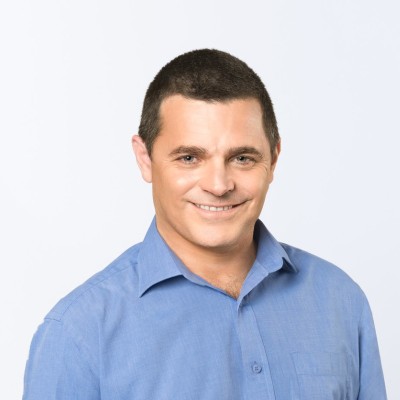
CEO
Hagay Levy holds a B.Sc. in Economics and Business Management, as well as a M.Sc. in Accounting and Finance. Hagay holds has more than 25 years of professional business and managerial experience as former C-level executive in various early-stage technological companies in different verticals. Companies include Modelity (acquired by LPA), Tippcom (acquired by Unicell) and Trilogical. Hagay established Iluria based on his personal experience as a father to four children with ADHD/ADD.


